
About eight years ago, I made a patchwork blanket based on a quilt block idea I had about ten years ago. I based the block on 4½" fabric squares. Early last month, I wondered if I could figure out a version of the block based on the square die sizes I have for my die cutter.
I did a little sketching and math and arrived at cutting the squares at 35mm, the squares that would be cut into half square triangles at 40mm, and the squares that would be cut into quarter square triangles at 45mm. Because I am not 100% committed to Perfect, I cut those squares into halves and quarters with scissors, so things were...variable...but workable.
The day I posted the previous project (still not happy with that), I cut enough squares and triangles to do a test, and made this

Success!
Then the tedium started, eventually getting to this

Eventually.
I used that test patch to roughly determine how many I'd need to cover all the main pieces of the short version of McCall's 8011
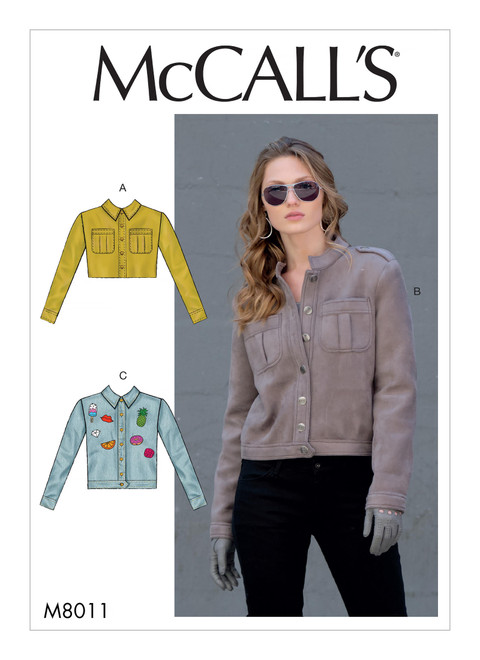
This image was grabbed from the Simplicity site, where the pattern is currently available only as a PDF. I got a paper copy when it was on clearance from the site last year. The photo on the envelope is...not great, looking even more like it's made from upholstery fabric than it looks here (going by the fabric recommendations, it's probably faux suede), and also dramatically but unhelpfully side-lit. I could see potential in it, and got it figuring I'd make view B in view A's length--and I still think I will, someday. The project in this post is view C in view A's length. (View A is supposed to have a raw lower edge. I'm not doing that.)
My rough estimate came to 60 cats + coordinating solid strips to make up the fronts, back, and upper sleeves. I saved figuring out the fabric for the lower sleeves, collar, cuffs, and all the bands for after I got the patchwork parts sorted out.
I set about cutting the hundreds of little fabric pieces, and eventually decided I should probably add 12 more sets, for a total of 72 of each.

The choice of white fabric for the cats was based purely on whatever solid I had enough of that I wasn't saving for another project. The pink for the noses was left over from a shirt, and the eye green is, I think, left over from this dress--well, most of the green: I had to call in a fabric of a similar shade, but different texture, for some of those additional 12 sets. I made sure to keep them matched when assembling the eye units of the patchwork.
And assemble units I did! With tiny stitches, and chained together so there's no thread waste between them, and also using the tex 24 polyester core thread so I could fit as much as possible onto the bobbin.


I also marked lines on the pattern center front opening edge and bottom to compensate for the way the patches themselves needed ¼" seam allowances to work, instead of the 5/8" the pattern wanted. There would be no problems with the standard seam allowances elsewhere. I assembled just enough to cover the pattern piece. (I see so many people on social media making patchwork for clothes, but they make full yardage and cut the pattern pieces from that like it's whole cloth, and I bite my tongue on telling them how much effort they waste by creating whole areas of solid patchwork that will just be cut away.) Once I cut the pattern piece for that side, I could see where I came up short and would have to go back and fill in later, and, more importantly, I could know just how many patches I needed to do the other side.
 I offset the layout on the other side of the center front opening, so it would continue the overall pattern, instead of mirroring the first side. You can also see some of the areas I fixed on the edge of the first side, and I would eventually go back and add some eyes and noses to the white silhouettes around the armscyes.

I laid out the back with one column of cats centered, and assembled one side completely before doing the other side. I had what I thought was the great idea to add a row of rectangles along the bottom, lacking any face details on the white, with the idea that it would work perfectly with the standard 5/8" seam allowance. And I'm sure it would have! But! I completely forgot about that when I sewed the side seams--oh, sure, the front and back didn't align, but I solved that by simply taking some length out of the back at the underarm! It would be a while before I realized what I'd done. The back waist seam ended up having to be ¼", too.

And it doesn't align with the layout on the front, either! It's fine.
I did the sleeves one at a time, too, assembling some part faces because I wasn't sure if I'd have enough of everything left to just use the whole eye and nose units on the sides that would be cut away.

I accepted that these would have 5/8" seam allowances all around.
And this is what was left of the patchwork units!

My math was probably completely fine, but, as with most patchwork I make for clothes, I made a lot of the pieces on the very edges from scraps that hadn't been big enough to cut into the sizes needed to make the whole blocks. Definitely better to have made too many than not enough! That said, I still have enough of several of the fabrics that I could have made more if needed.
At that point, I allowed myself to choose the contrast and lining fabrics needed to assemble the whole jacket. Technically, the pattern does not call for lining, but there was no way I was leaving all of those patchwork seams exposed, and, also, the way this jacket is constructed, adding a lining was fairly straightforward.

That doesn't mean I didn't overthink it, of course. The only place where the lining is stitched directly to the shell is at the sleeve openings above the cuffs. I tried maneuvering everything around in my mind as I was falling asleep over a few nights, and I just couldn't make everything work. However. I recognized that I was very probably overthinking it, so I just went ahead and sewed things together the way I thought they should go, and it all worked out with no problem.

I sewed the upper sleeve to lower sleeve on the shell and also on the lining, then sewed them together around the areas left open, sewing each side separately. Then I sewed the shell sleeve to the shell armscye, leaving the lining free, repeating for the other side. Then I sewed the sleeve lining to the lining armscye on both sides. After that I sewed the shell side and sleeve seams, and then the lining side and sleeve seams. This left both lining and shell inside out, attached only at the sleeve openings. Turn the shell right side out and, taadaa, the lining is nestled inside right where it should be. I knew this was how it should work, but I could not get my brain to imagine the correct physics of it. Glad I went ahead and did it anyway!

The striped fabric had spent some time as kitchen curtains, replaced year before last. Once the curtains were taken down, the fabric went back into my stash, appearing in a bag I made last year. I wasn't sure if I really wanted to use it for this project, until I had all of the patchwork assembled and the pattern pieces cut and sewn together.
I was especially uncertain about the lower sleeves, being momentarily tempted to make those from patchwork, too. I let that moment pass.

Ideally, the lining would have been white, just because of the show-through of the white patchwork parts, but I really like the way this purple (purchased the last time I visited the craft thrift store) looks with the rest of the colors. As I said: Very Valentines Day.

I sewed the bands, cuffs, and collar in my usual way, by pressing one edge before assembly, and sewing the unpressed edge to the inside, folding the pressed edge around to the outside and edge stitching it down from the outside. The stitching visible on the inside isn't perfect, but no-one else is going to see it, and, most important: no hand stitching needed.
As always, I didn't choose buttons until it was time to sew the buttonholes. I did know I wanted them to be white, so that helped narrow the options.

And then I procrastinated a few more days. When I finally decided I wanted to get this project finished, I installed the vintage buttonholer and started sewing the first buttonhole and immediately had the bobbin thread run out. Sigh.

I got over that relatively quickly and refilled the bobbin (I switched from the tex24 for the patchwork to my usual Saba C tex 40 for the structural seams and top stitching.) The four buttonholes on the front went smoothly, as did the first buttonhole I did on the cuff...until I realized I had sewn that on the wrong side. Another sigh. I very slowly picked out those four layers of dense zigzagging and put the project aside for the evening, fearing what other mistakes I might make in the rush to finish it that night.
I picked it back up this morning and everything went smoothly again, and here we are.

Reviews for this pattern mention that it's boxy, and that it very much is. I think it will balance out if I wear it over a high waist dress with lots of volume in the skirt, which is something I do wear a lot when it's not excessively cold outside. (We recently had an ice storm followed by extremely low--for this area--temperatures. I wore this wool jacket the entire time.) I'll still probably make the back less wide at the waist whenever I make this pattern again, and have scribbled a note on the pattern about it.
Will I make something with the cat patches this small, or as numerous, again? Probably not.

But the result is fun.


OH my goodness.... that jacket is fabulous!!
ReplyDelete